







































Chita Andolan: When Development Begins to Burn Tribal Rights
The ‘Chita Andolan’ against the Ken–Betwa River Linking Project highlights a growing conflict between development goals and tribal rights, where displacement threatens not just land, but identity and survival.


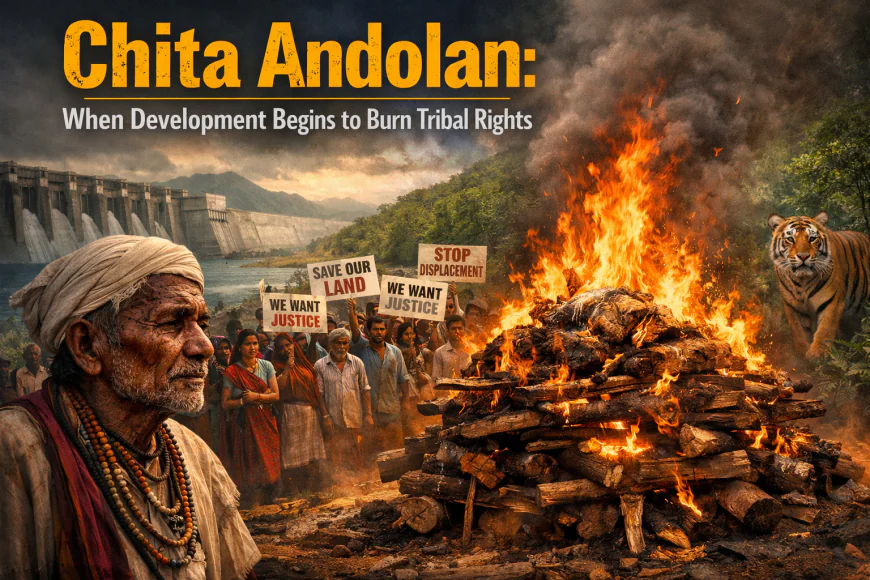


Large-scale development projects in India have long been framed as engines of progress, promising economic growth and regional transformation. However, the emerging ‘Chita Andolan’ against the Ken–Betwa River Linking Project reveals a far more complex and troubling reality—one where development risks colliding with legality, environmental sustainability, and the fundamental rights of tribal communities.
The Ken–Betwa River Linking Project is envisioned as a solution to chronic water scarcity in the drought-prone Bundelkhand region. By transferring water from the Ken River to the Betwa basin, the project aims to boost irrigation, improve drinking water access, and support regional development. Yet, its implementation has exposed significant procedural gaps and ethical concerns.
A particularly striking issue is the phenomenon of dual displacement. Of the 24 villages affected, eight are set to be submerged due to the dam construction and fall under the provisions of the Land Acquisition, Rehabilitation and Resettlement (LARR) Act, 2013. Meanwhile, sixteen villages are being relocated to facilitate the expansion of the Panna Tiger Reserve under the Wildlife Protection Act, 1972. This overlapping framework has created legal ambiguity and inconsistent rehabilitation measures, leaving affected communities in a state of uncertainty.